Washington Clean Buildings Tier 2 filings, prepared and submitted for $0.13 a square foot.
We prepare the whole filing, and a qualified energy manager in Washington reviews your building and signs it with you. The state's incentive, paid by your utility, is up to $0.30 a square foot, first come, first served.
Clean Buildings Filing is a private business. We are not the Washington State Department of Commerce and are not affiliated with it.
Your price
Our fee for the complete filing
$4,550a building
$0.13 a square foot, rounded to the nearest $10, and at most $6,400 a building.
Or look up a Seattle building
This searches the City of Seattle's 2025 benchmarking record. For a building elsewhere in Washington, enter its floor area above.
Washington's Tier 2 incentive and deadline
up to $10,500
at the base rate, if Commerce certifies the building and your utility pays
The base incentive is $0.30 a square foot, not counting parking and unconditioned or semi-conditioned space. Participating utilities pay it, first come, first served, and a payment can be reduced, delayed or zero.
As of November 10, 2026, Commerce had awarded nearly $15.5 million of the $150 million fund, and over $134 million was left. Commerce's incentive page.
Checked November 25, 2026.
Tier 2 compliance deadline
July 1, 2027
Who signs
Form A, the filing's summary of compliance, is signed by the building's owner, by its energy manager and by a qualified energy manager. Commerce's guidance lets the energy manager be the owner, an employee or a contractor the owner retains. We provide the qualified energy manager. That person works in Washington under contract with us, reviews every building, and signs only when satisfied with it. You will see the name on the one-page authorization you sign when you engage us. If your company already has a qualified energy manager, we prepare the documents for that person to review and sign.
What we do, and what you send
We do
Benchmarking in Portfolio Manager
The standard asks for 12 consecutive months of the building's total energy use in ENERGY STAR Portfolio Manager, from no more than two years before the filing. If the building already has a Portfolio Manager account, we work from it. If it has none, we set one up with you, and you authorize your utility to send the data.
We draft
The energy use intensity target
The rule gives this calculation to the qualified energy manager. We prepare the worksheet from the building's floor area, activity type and operating hours, and the qualified energy manager sets the figure that goes on Form B. The target is reported with the filing, and a Tier 2 building is not required to meet it at this time.
We write
The energy management plan
We write the plan for your building in the order of Commerce's own template, and complete Commerce's Energy Management Plan Reporting Tool, which has to be attached to the filing.
We write
The operations and maintenance program
We build the program from your equipment list. It sets out what is inspected and maintained, how often and by whom, and it comes with a log for your staff to keep. Commerce's Operations and Maintenance Reporting Tool goes in with it, completed.
You send
An intake, equipment photos and maintenance records
The intake is short and covers the building's hours, occupancy, utility account numbers and maintenance provider. We also ask for a photo of the label on each main piece of equipment, and for the preventive maintenance records you already keep. Commerce's Clean Buildings staff told us by email on October 5, 2026, that Commerce sets no minimum time for the program to have been in use. Ideally the first round of each task is done and documented, and where the records are kept outside Commerce's own O&M tool, an example of completed preventive maintenance is what the filing needs. The examples given were signed service contracts, maintenance-system screenshots, spreadsheets, paper boiler logs and completed unit-turnover checklists. A building with no records logs one round of its scheduled checks before we file, which takes about a month.
You give
Shared access in the Portal and Portfolio Manager
You claim the building in Commerce's Clean Buildings Portal and give Shared Access there to us and to the qualified energy manager. You share the building with both of us in Portfolio Manager as well. Nobody shares a login.
We file
The filing, which is also the incentive application
When the owner, the energy manager and the qualified energy manager have signed Form A, the filing is submitted through the Portal. Commerce treats the compliance application as the incentive application, so no separate application is needed.
Prices
$0.13a square foot
The complete filing
Everything in the list above, with the qualified energy manager's review and signature, submitted to Commerce. Rounded to the nearest $10, and at most $6,400 a building up to 64,000 square feet. A larger building is quoted on its own, and a written quote we have already sent stands.
$0.05a square foot
Documents for your own qualified energy manager
If someone at your company is a qualified energy manager, we prepare every document and worksheet for that person to review, sign and submit. Rounded to the nearest $10, and at most $2,490 a building.
10%off
Five or more buildings
An owner or manager with five or more Tier 2 buildings pays 10 percent less on every building, the first included, at either price.
How payment works
- A signed agreement first
- Work starts when you have signed an engagement agreement. It sets out the scope, the fee, and the payments and refunds described here, and it limits our liability to the fee paid for the building. The one-page authorization sets the same limit for the qualified energy manager. Nothing is due on signing.
- Half when the documents are ready
- When the documents for a building are ready, we send review copies marked as drafts, with an invoice for half the fee. We release the clean documents when that payment clears.
- The rest before Form A is signed
- When the qualified energy manager has reviewed the building, we invoice the second half. Form A is signed and the filing submitted once that payment clears.
- By bank transfer
- Both invoices are paid by bank transfer (wire) in US dollars. We do not take cards.
- Refunds
- If the qualified energy manager will not sign a building, we refund what you have paid for it, unless the reason is information or access you have not given us. If Commerce does not certify a filing after we have corrected it once, we refund that building's fee.
- How long it takes
- A building's documents are ready within 10 business days of its complete intake, and the qualified energy manager's review takes up to 10 business days more. For five or more buildings, we set the order and the dates with you. Commerce says its review takes up to 30 business days and the incentive up to 14 more, depending on how many applications it has. Your utility then contacts you about payment, and may ask for a W-9.
A sample filing
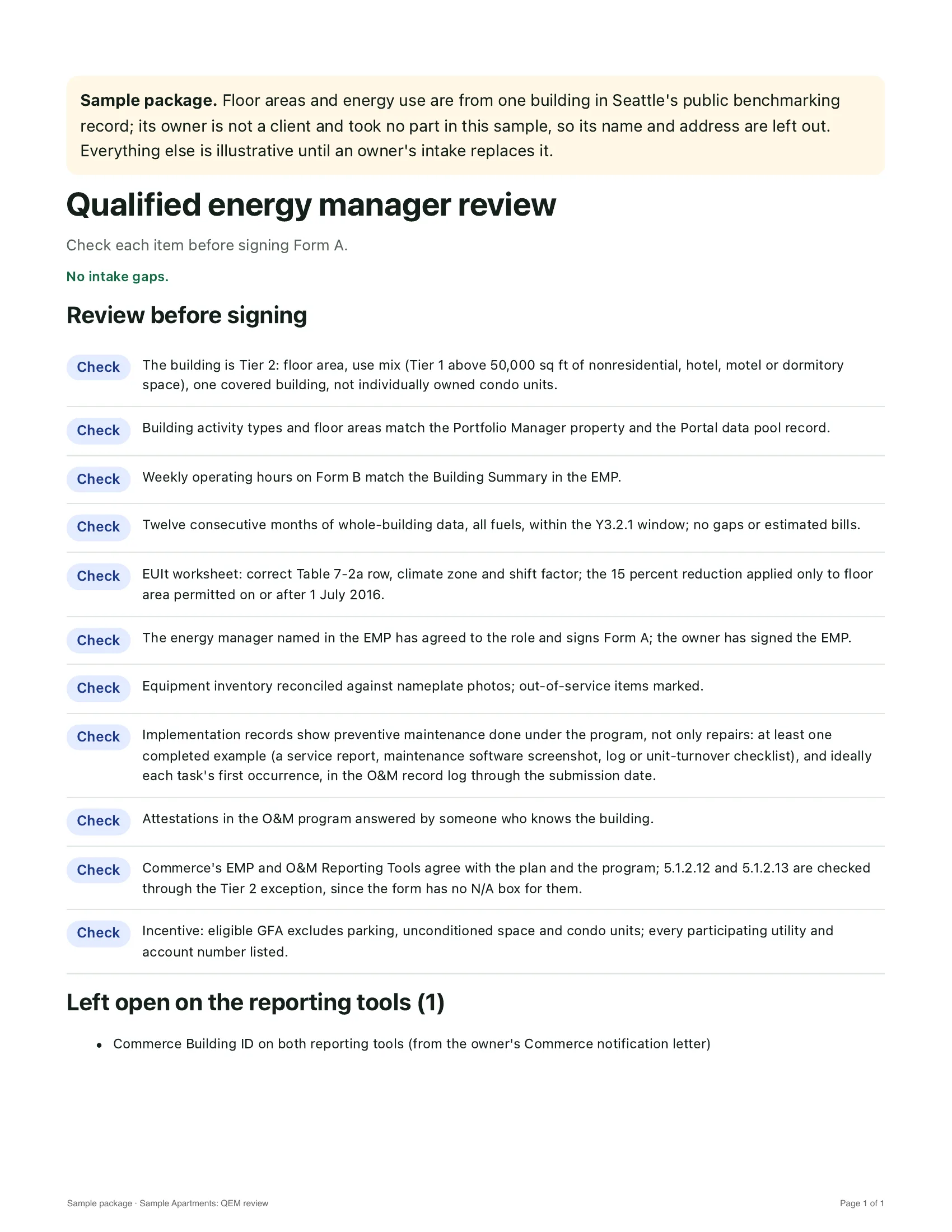
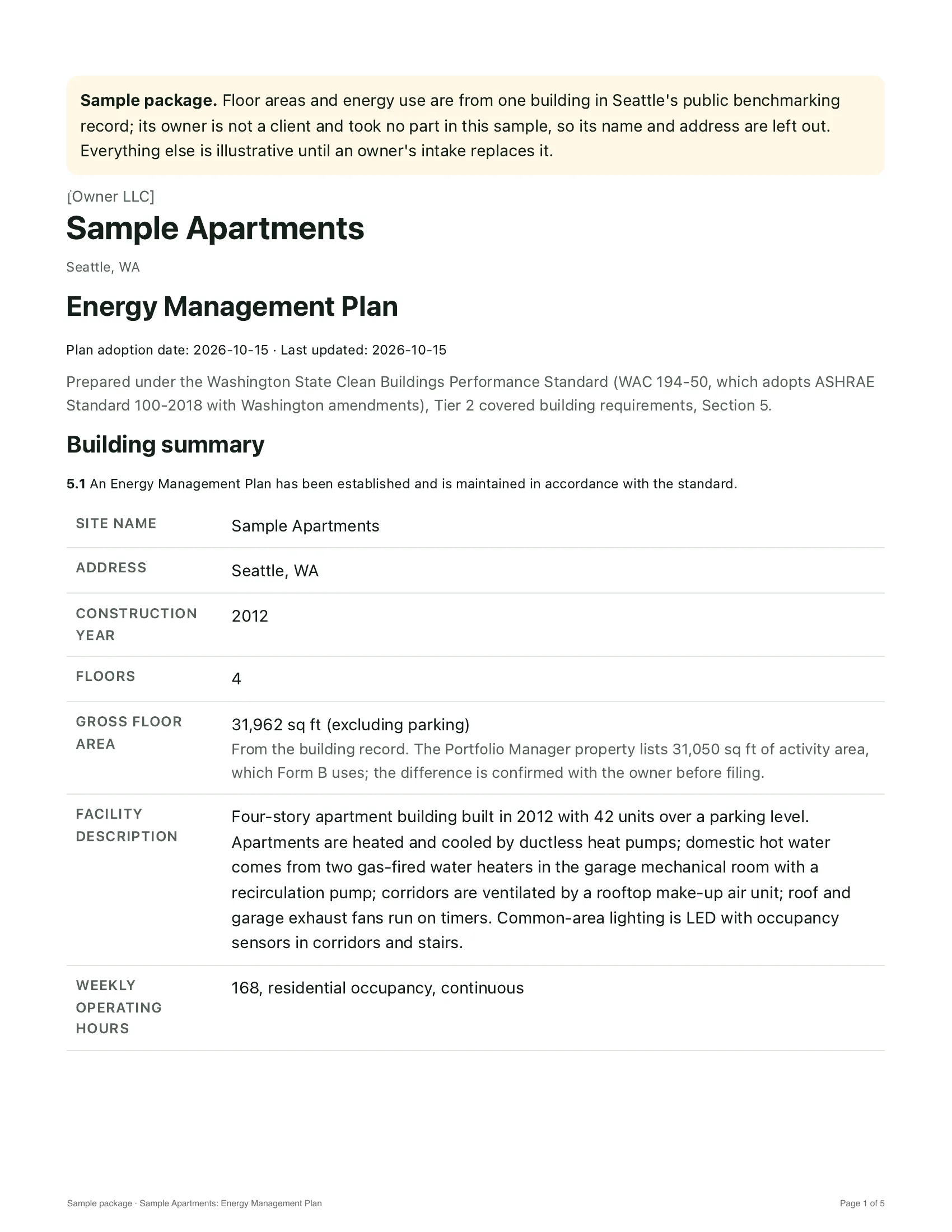
We prepared a sample package for a Seattle apartment building from the city's public benchmarking record, and everything beyond that record is illustrative. It runs to 53 pages. Two of them are on this site, the qualified energy manager's review checklist and the first page of the energy management plan.
Guides for owners
Each guide answers one question from Commerce's own pages and the law, with every official source linked and the date we last opened it.
- What Tier 2 compliance costsWhat a Washington Clean Buildings Tier 2 filing costs to do in-house or to hire out, what the state's incentive pays back, and what not filing costs.
- The July 1, 2027 Tier 2 deadlineWhat Washington Tier 2 owners must submit by July 1, 2027, what Commerce can do after that date, and how the incentive relates to it.
- The two-year Tier 2 extensionWho can ask Commerce for a two-year extension of the Tier 2 deadline, on which grounds, when the window is open, and what an extension does and does not change.
- Tier 2 exemptionsEvery ground on which a Washington Tier 2 building can be exempted from the Clean Buildings standard, the January 1, 2027 date to apply by, and how to apply.
- The Tier 2 letter from CommerceWhat the Department of Commerce's Tier 2 notification letter is, how to check that a letter, call or email is really from Commerce, and what to do next.
Questions
Are you the Department of Commerce?
No. Clean Buildings Filing is a private business, and nothing we send is an official notice. Commerce's Clean Buildings page asks owners who receive a communication that seems suspicious to contact it before acting, by email at Buildings@Commerce.wa.gov or through its Customer Support Form, and says it can verify whether the communication is legitimate. That applies to anything you receive from us. Our emails to owners come from an address at stratumics.com and open by saying that they are an advertisement from Clean Buildings Filing, a private filing service that is not part of the Department of Commerce.
Why pay a business in Guyana?
Clean Buildings Filing is a service of Stratum Integrated Core Systems (Stratum ICS), a business name registered in Guyana under certificate number 300288, in Georgetown. A Tier 2 filing is documents and Portal entries, which we prepare by email and shared access. Commerce's Clean Buildings staff told us by email on October 5, 2026, that there is no specific requirement to review a building in person, and that Commerce strongly encourages a site visit. Our qualified energy manager in Washington reviews each building from its documents, records and equipment photos, may ask your site contact for a live video walk-through, and signs. Our invoice comes from another country and is paid by wire, so nothing is due until the documents for your building are ready for you to read.
Is the incentive certain?
No. Commerce approves the application and the utility that serves the building pays, first come, first served, until the $150 million fund is used. The building must be served by a participating utility, and Seattle City Light, Puget Sound Energy, Avista, Pacific Power, Tacoma Power and Clark Public Utilities are among the 24 on Commerce's list. Commerce says a payment can be reduced, delayed or zero if the utility's tax credits run short. State law keeps incentive applications open through June 1, 2030, later than the July 1, 2027 compliance deadline. Our guide to the deadline sets out what Commerce's incentive page says about the dates. Our fee does not depend on the incentive being paid.
What access do you get, and when does it end?
In Commerce's Clean Buildings Portal you give Shared Access to us and to the qualified energy manager. In Portfolio Manager you share the building with both, with rights to edit its property and meter data, or read-only if you prefer, and without the right to share it onward. Nobody shares a login. The one-page authorization you sign sets out the qualified energy manager's access, requires that person to report each change made in Portfolio Manager, and has you remove both accesses once Commerce has certified the building and decided its incentive application, or earlier if you choose.
What if Commerce does not accept the filing?
Commerce reviews filings in the order it receives them and tells the applicant whether the requirements have been met. Its incentive guidebook says an applicant whose application is denied may resubmit and ask for a re-review. We answer Commerce's questions within two business days and prepare the correction, and the filing is signed again and resubmitted. Our refund terms cover a building that Commerce still does not certify.
What if we do nothing?
The reporting deadline is July 1, 2027. If nothing has been filed by then, Commerce may send a notice of violation, and the rule gives the owner at least 30 calendar days from that notice to comply. The penalty is waived for an owner who files in that time. For an owner who does not, it is up to $0.30 a square foot for the five-year cycle, which comes to $9,000 for a building of 30,000 square feet. An owner who needs more time can apply for a two-year extension, on one of five grounds, between January 1, 2027 and January 1, 2028.
Can we do the filing ourselves?
Yes. Commerce's templates and tools are free, and so is its qualified energy manager course. The qualified energy manager may be the owner or an employee who has completed that course and has two years of experience with commercial building operations or building energy management, or another qualification the rule lists. Someone still has to gather 12 months of energy data, write the plan and the maintenance program, and complete the Portal forms. That work and the signature are what we charge for.
Send us a building
Send the building's address, and its Commerce Building ID if you have it. Sending one costs nothing and commits you to nothing. We reply by email within one business day to confirm that we can take the building, with a written quote and a list of what is left to do for it. We do not yet take buildings in Snohomish County or on Camano Island.